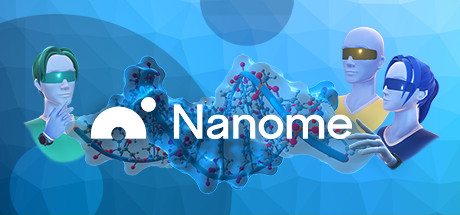
Nanome
Developed by Nanome Inc.
Published by Nanome Inc.
Available on:
🔒 Professional Analytics
Get detailed market data, player sentiment analysis, competitive insights, and more.
About This Game
Publication: Development of a virtual reality platform for effective communication of structural data in drug discovery
We are excited to announce that we have been collaborating with The Genomics Institute of the Novartis Research Foundation (GNF) and have co-authored a paper that is being published in the Journal of Molecular Graphics and Modelling. The paper, titled “Development of a virtual reality platform for effective communication of structural data in drug discovery”, discusses how the immersive nature of virtual reality can help scientists better understand the nuances and features of molecular structures.
The goal is to reduce the time required to thoroughly understand the spatial and structural properties of protein complexes and drug-target binding sites through more effective communication between structural biologists, chemists, and discovery scientists from various disciplines while enhancing idea flow, creativity, and cross-site collaborations within drug-discovery teams.
The paper is available here:
If you are interested in the enterprise edition of our software or would like to learn more about our team feel free to contact us at hello@nanome.ai
Sincerely,
The Nanome Team
Nanome is Advancing Crystallography
Crystals are some of the most useful, interesting, and complex 3-dimensional structures in the world. To most, crystals are gems found in geodes and rings. However, crystals are of core significance to researchers in nanotech and chemical synthesis, like structural biologists.
For instance, in the drug discovery process, computational chemists work with protein engineers to create nano-medicine. Drug design is a massive undertaking, requiring data science, visualization, and lots of plotting. Before any computer-aided drug design, even a small molecule, is ready for any of this analysis, it must undergo crystallography. Simply put, to modify a structure, a chemical designer needs to know what it looks like — then the molecular modeling process can begin.
Given the versatility and importance of crystals, crystallography is a most important field of modern research, essential to the study and engineering of nanoscale systems.
Modern Crystallography Visualization
Today, researchers have utilized X-ray crystallography to map over 13,000 macromolecule structures — if you have ever looked at a representation of a protein, the data behind it was probably created by a crystallographer (with a powerful X-ray blaster).
Viewing a protein in VR.
Atomic-scale study and manipulation of crystals presents a challenge. By nature of their three-dimensionality, crystals are difficult to represent and explain in widely-used two dimensional mediums, like typical computer monitors. To suit the needs of engineers and students working with crystal structures and improve the efficiency their workflow, more powerful and intuitive tools are necessary. That’s where Nanome comes in:
Tomorrow’s Crystallography Laboratory
Nanome is a collaborative molecular design platform in Virtual Reality. It enables everyone from students to professional engineers to improve their intuition and develop new insights into nanoscale phenomena and molecular systems.
Intuitive interaction with crystal structures in Nanome.
When holding once-abstract and conceptual structures, like proteins, in your own two hands, a new sense of comfort and intuition naturally arises. UCSD’s Professor Zoran Radic, Principal Investigator on NIH-funded protein structure research, says that “looking at [protein] complexes in VR yields much more immediately obvious conclusions than any other kinds of visualization.” Within moments of entering VR, many of Professor Radic’s crystallographer colleagues develop new insights and understandings into their own structures.
VR Protein Structure visualization unlocks a world of value for crystallographers, and their reactions show this. This leads us to ponder the insights and value Nanome could bring to crystallographers involved in non-protein fields of research like piezoelectronics. For example, with crystal lattice visualization, researchers could make intuitive leaps in the optimization of materials with structure-dependent electromechanical properties.
Next Steps
Nanome has taken a huge step towards improving the tools of crystallographers by implementing electron density maps. These maps, containing a crystallography experiment’s direct results, are essential for advanced research. To Nanome it’s clear: innovations of the future will occur at the nanoscale. The first step is building the right tools.
About the Software
Step into Nanome and experience the world at the molecular level. From drug discovery to chemistry class, Nanome is a powerful tool for research and education. Visualize, design, and simulate chemical compounds, proteins, and nucleic acids like never before. Collaborate remotely in real-time, save workspaces, and share. Leading pharmaceutical and biotech companies use Nanome to accelerate drug discovery and collaborate with distributed teams across the globe. Educators at top universities use Nanome to teach chemistry in virtual reality, allowing students to explore shapes of proteins and drug compounds and to learn how these structures explain function.Features:
- Load from RCSB, PubChem, Drugbank or from your local computer
- Host a password protected room
- Join private rooms
- Save VR workspaces
- Assign presenter & block users
- Export molecules in PDB/SDF format
- Play Trajectory Animations
- Multi SDF Ligand support
- Electron Density Map Support (CCP4 & DSN6)
- Load unlimited molecules
Publication in the Journal of Molecular Modelling:
Nanome is available on all the major VR stores such as Oculus, Viveport, and SideQuest.
Download Nanome today and experience the future of molecular design.
Publication in the Journal of Molecular Modelling:
Official Documentation Site:
System Information
Age Rating
All Ages
You Might Also Like
A Hat in Time
A Hat in Time is a cute-as-heck 3D platformer featuring a little girl who stitches hats for wicked powers! Freely explore giant worlds and recover Time Pieces to travel to new heights!
Europa Universalis IV
Rule your land and dominate the world with unparalleled freedom, depth and historical accuracy. Write a new history of the world and build an empire for the ages.
The Precinct
Averno City, 1983. Gangs rule the streets and your father lies restless in his grave. Clean up the city, uncover the truth, and embark on thrilling vehicle chases through destructible environments in this neon-noir action sandbox police game.

Mechabellum
Mechabellum is a rewarding tactical wargame where you gain victory by adapting your strategy and outthinking your opponents. Command a mechanized army in battles against humans or AI, customize your units and strategically place them on the battlefield to watch them destroy your enemies.

Nine Sols
Nine Sols is a lore rich, hand-drawn 2D action-platformer featuring Sekiro-inspired deflection focused combat. Embark on a journey of eastern fantasy, explore the land once home to an ancient alien race, and follow a vengeful hero’s quest to slay the 9 Sols, formidable rulers of this forsaken realm.

Want Professional Game Market Data?
Access detailed analytics, player sentiment analysis, competitive insights, and market positioning data for Nanome and 150,000+ other games. Perfect for developers, publishers, and analysts.